International development: From moralizing to calculations to laissez-faire to rhetoric
A review of Christian Christiansen’s “Designing Global Economic Equality”

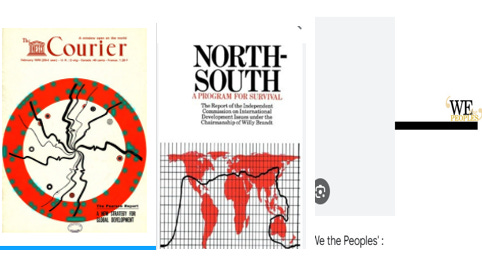
The just published book by Christian Christiansen Designing Global Economic Equality: The Making and Unmaking of Global Egalitarian Policies at the United Nations provides an intellectual review of the history of the idea of global inequality. It follows recent excellent books by Samuel Moyn Not Enough: Human Rights in an Unequal World and Quinn Slobodian Globalists: The End of the Empire and the Birth of Neoliberalism and Hayek’s Bastards: The Neoliberal Roots of the Populist Right (reviewed on my Substack here, here and here) in evaluating the transition in the intellectual discourse and in international politics of the ideas of global poverty, global inequality and global development. The scope of Christiansen book is narrower than that of the other two which often move into the arena of economic and political history.
Among the three “globals” I mentioned above Christiansen focuses only on one dealing with inequality. Global inequality, as Christiansen writes, and as it becomes clear to the reader, meant many things to many people. It entered the jargon of economics already in the 1950s. Colin Clarke’s Conditions of Economic Progress published in 1940, but then forgotten during the war, and resuscitated after 1945, played a very important role by putting numbers on the huge gap (“the chasm”) that existed between the developed Europe and the US, and impoverished Asia and Africa.
In the early 1960s, many African countries become independent and the rich would discover poverty in the Third World; not that that poverty was unknown before, but now, when the countries became independent, the Third World poverty acquired a political meaning: poor nations of Africa and Asia could be easily tempted by the “false promise” of communism and become allies of the Soviet Union. There is thus an element of self-interest from the very beginning of Western involvement in “solving” mass poverty in Africa and Asia. There were, nonetheless, other elements too: the success of the Marshall Plan in Europe that implied that aid can jumpstart economic development, and a turn toward the welfare state which could be interpreted, and was interpreted by some including Jan and Alva Myrdal, that it naturally must lead to a global welfare state. In other words, the world should ultimately become a greater Sweden. These hopes were, of course, soon disappointed.
The era of two overestimations. I would like to name the period from the early 1950s to the introduction of the New International Economic Order in 1974, “the period of two overestimations”. The first was the overestimation of the willingness of rich countries to provide aid. Innumerable individuals (beginning with quasi omnipresent in the book Barbara Ward) and likewise innumerable international commissions composed of equally innumerable wise men (mostly men), totally overestimated the likelihood that the rich countries would spend a sizeable share of their GDP on economic aid. The original target, in the 1960s, was 1% of the rich countries’ GDPs. It was then scaled down to 0.7% of GDP. Like many UN objectives and “pledges”, it was ignored. Today, rich countries’ foreign aid is estimated at less than 0.3% of GDP and lots of that includes military transfers, or aid that can be understood only in terms of political geostrategics, not at all in terms of alleviating poverty and reducing inequality between the (somewhat awkwardly) labeled Global North and Global South.
The second overestimation was that aid could propel poor countries’ growth. That practically never worked. The Marshall plan was a singular exception, but it was an exception (we understand it much better now), because Europe needed capital but had everything else: highly qualified labor force, variety of already built industrial factories that just needed raw materials (and thus foreign exchange) to begin producing again, well-known and much used markets. None of that existed in the newly decolonized countries in Africa and parts of Asia.
Those two over-estimations went together with a somewhat otiose language of moral responsibility of the North, the rhetoric couched in ethical terms, and not in terms of restitution for the harm of colonization (although there were, as Christiansen writes, such authors as well); and often in the wooden language –cited too many times--- of the many reports (the Pierson report, Columbia Conference on International Development, the Brandt report). Christiansen gives copious quotes from many of these repairs and one becomes quickly incredulous that authors truly believed that vague--and invariably vain—appeals to moral conscience of the rich and to their ill-defined responsibility for poverty in the Third World would ever have any traction in real life. Perhaps our era is much more cynical, but making such abstract calls for action—that invariably are vague as to who and how should do things—seemed rather written to display moral virtues of the writers than to lead to some measurable change. Robert McNamara, the engineer of body-counts, is no less morally disposed in the appeals to the conscience of the West than the indefatigable Barbara Ward who became his close advisor (after, or perhaps simultaneously as, advising the Popes and many other influential personalities).
The most interesting person of the period is Raúl Prebisch. Prebisch was a structuralist (even if he was not sure he agreed with such a description) who made points that were understandable and sensible: the international system was systematically skewed in favor of rich countries (for example, by ruling out nationalization of multinationals working in poor countries), by protecting Western industries against the nascent industries of the South (and thus making export growth of the South more difficult), and finally by profiting from the long-term movement of terms of trade against agriculture. Prebisch thus saw poor countries, and especially his native Latin America (he was born in Argentina), locked in a situation where they were short of foreign exchange to start serious import substitution (which obviously requires, at first, technological imports from the North), impotent in their dealings with Northern multinationals, and are stuck with production of raw materials whose relative price is on a long-term decline. Moreover, high inequality in the South leads to wasteful expenditure by the elite on luxury goods thus additionally reducing the funds for “primary accumulation” and growth. Even if Prebisch was wrong on the long-term evolution of the prices of primary commodities, his basic story made sense then, and continues to do to some extent even now. What better example than China which indeed faced all the issues listed by Prebisch but was able, by improving its position vis-à-vis foreign investors to conquer their technology, move to higher value-added production, not waste too much money on luxury consumption, and achieve extraordinarily high rates of growth.
As this short sketch of Prebisch shows, he was no great friend of neoliberal approach to global inequality according to which poor countries should just follow the path of the rich: find the right niche in the international division of labor and go along the stadial development à la Walt Rostow (another important development economist who is, unfortunately, not much mentioned by Christiansen). It is no surprise that Prebisch got into a couple of nasty quarrels (unusual for him) with Milton Friedman and neoclassical economists who, from the late 1970s, dominated the field of “global inequality” and development.
We thus enter into the second phase that may be dubbed that of “neoliberal globalization”. The rule here was: countries should simply follow market signals and grow. It was a naïve doctrine. While the moralizing doctrines of Barbara Ward and Jan Myrdal were naive in their assumption that there is such a political or moral entity as “global community”, the neoclassicals were naïve in believing that unmolested markets will make everybody rich, or at least no longer poor. While one group was naive politically, the otter was naive economically.
This transition, occurring at around the ninth decade of the 20th century is much discussed in both its national and global aspects. It is notable that Christiansen links the economic disputes of the period with those in the field of international relations. A precursor to the move to the right in economics was, Christiansen writes, Robert Tucker (Inequality of Nations, 1977) that hailed back to political realism: the real—the only--actors in the world of international economics are states. States have interests but not ethics. The global community does not exist. The neoliberal turn thus took as its underpinning a very realistic (in the sense of the so-called realistic theory) view of international relations.
As must have become clear to the reader up to now, the term “global inequality” in reality meant, most of the time, contrasting some average numbers for the North and the South: average GDP per capita, or average life expectancy, or average school attainment. For me, since the work on global income or wealth inequality has become possible (thanks to more plentiful data), ”global” means inclusion of all individuals in the world, not simplified by an average quantity but with their actual incomes or wealth. In Christiansen’s book, reflecting much less empirically rich times, it was simply a gap between the North and the South. This point is important to make because a similar confusion (do we compare the mean against the mean, or do we take all individuals and look at global distributions?) continues, not infrequently, today. Both pictures have validity and use, but the one that looks at all individuals in the world is of course hard to create but is richer in its empirical and even political meanings. Neither the North, nor the South can be usefully summarized by one number. In today’s world even less so than in the past.
Finally, we come to the almost-present where the book ends: to the period of “embedded globalization” or “inclusive capitalism” where neoliberal globalization was, in words, tamed by market consultants and the UN. It is a rather bizarre phase in the evolution that we, following Christiansen, chart here. Under the pressure of the Asian financial crisis, Seattle and Genova riots, market consultants had devised the idea of “responsible capitalism” or “embedded capitalism” such that companies will continue making money, but now, they argued, companies would do so by focusing on green technologies, treating workers nicely, and doing similar implausible things. UN, short of money and ideas, bought that phantasy and we are treated to no fewer than three speeches, delivered year after year by Kofi Annan, then General Secretary of the United Nations, at Davos (where one wonders why, in the first place, the head of an inter-state organization should go at all). The whole discussion, including in Christiansen’s book, becomes murky here. It is not clear what UN and international organizations believe any longer the policy to reduce the gap should be. We are lost in a fog of fantastic statements where all contradicins between business and state, the poor countries and the rich, the powerful and the weak seem to have been solved, at least by a rhetorical sleight of hand. It was probably intellectually the most barren period.
Christiansen’s book is, for the students of development economics and international relations, and people like me who study world inequalities, enjoyable and very well documented. There are many things to learn. It covers the political West-Third World relations since the end of the Second World War in detail. It uses mostly the UN as the forum where they were intellectually played out. Development economists, not linked to international organizations, play a secondary role; macro economics is not much mentioned, and the Soviet bloc and China are totally absent. I also think that more attention should have been paid to the New International Economic Order. It is a complex project: it stood for certain principles of the UN much more so than the political West, but it also rejected interference in domestic affairs and hence the protection of human rights. It wanted to reduce inequality on its own terms, but its “reign” was short-lived. It ended with the increase of US interest rates that plunged the Third World into insolvency, reimposed the role of the IMF and brought the original hierarchy back. Except…except for many in Asia who grew faster than ever and redefined the meaning of North-South relations.
If you want to look at the sources of inequality look at who grabs and holds land (all natural resources) and patents of monopoly. Henry George predicted this in 1879. First come, first grabbed is not a good theory of property. It denies intergenerational equality of opportunity. As for patents they should be abolished or taxed out of existence.
I think that the most interesting lesson is the one Prof. Branko draws from Prebisch and China: development is not just aid, morality, or markets. It is about changing a country’s position inside the international system, absorbing technology, moving into higher value-added production, disciplining elite consumption, and building domestic capacity.
That is why China matters so much in the history of development. It did not wait for global equality to be designed for it. It reorganized its own position inside the global economy.