
As some people who follow my Substack might have been noticed I have been reading this Summer several books about the current Ukraine-Russia war. I find it very instructive and useful to read books that to some extent go back to the less well known origins of the conflict, that is to the breakup of the Russian Empire and the Civil War which followed rather than the presently published books. In fact, during that time the same forces that have led to the current war became quite obvious including an extraordinary heterogeneity of political and ethnic forces in Ukraine.
I have so far reviewed two of the books that deal with that period: Richard Pipes’ “The Foundation of the Soviet Union” and an extraordinary memoir by Viktor Shklovsky covering the two Russian Revolutions in 1917 and the years of the Civil War 1918-21. Both are excellent books and they treat of the same events but from a very different perspective. Pipes has a historian’s point of view and Shklovsky that of a participant, witness to these events as well as of a litterateur. I have also read recently two books that deal, in broad brushes, with the history of Russia: the first by Vladislav Inozemtsev entitled (in Russian) “A non-modern country”, a very critical look at today’s Russia (for a nice summary of Inozemtsev’s views see here), and a more recent book by Sergei Medvedev “A War Made in Russia” that is, among other things, superficial in its treatment of the economic catastrophe of the 1990s which brought to power Putin and led to the popular acceptance of his “vertical of power.”
I have just finished reading “Towards the Abyss” by Ukrainian political scientist and political activist Volodomir Ishchenko. I have read a number of his pieces before. They are always distinguished by not being simplistic analytically, and by taking the political economy of the Russo-Ukrainian, at first conflict, and ultimately war, seriously. Ishchenko takes a clear class attitude in the explanation of interests of different political factions in Ukraine. “Towards the Abyss” collects Ishchenko’s articles written from the Orange Revolution (2004) through the 2014 Maidan uprising (or the coup; or both as Ishchenko argues), all the way to 2023 when the Russian war against Ukraine had already entered the second year.
It is not the discussion of the war that I found most remarkable but the fact that it is the first, or surely one of the first, books about the post-socialist societies that tries to define the class structure of such societies and to take it as an explanatory tool in order to better understand political and economic coalitions. Ivan Szelenyi had a somewhat similar approach in a book and several articles published in the late 1990s and early 2000s, but that type of analysis has since become rare. It is a striking fact, for example, that no article or book treats of the Wars of the Yugoslav Succession from the class or social perspective. All, or almost all, deal only with ethnicity and religions. When economics is present it is always in the form of each republic complaining to have been exploited by others. Clearly, again, an ethnic point of view.
The post-Soviet scene does look different from the parties and coalitions and political classes that exist in post-socialist Eastern Europe. The post-Soviet, and especially the Ukrainian, scene is more complex because economic interests mingle with ethnic and language issues creating a tapestry of overlapping interests and identities, and thus conflicts. In ethnically homogeneous countries (as almost all post-partition communist countries had become), things are much simpler precisely because the two variables that play such a big role in Ukrainian politics, ethnicity and language (the latter being totally a variable of its own since it does not necessarily coincide with ethnicity), are much less important.
Reading Ishchenko’s reflections collected over the years one is inevitably reminded of similar articles that were collected in Marx’s “Civil War in France” and “The Eighteenth Brumaire”. Marx was likewise confronted with the difficulty of putting the French society at the time, with its numerous classes, within the straight jacket of English political economy that he inherited from Smith and Ricardo. It was difficult for Marx to see where he would put, for example, French peasant small-holders who represented about 30% of the population and were basically non-existent in England. They were neither capitalists, nor hired workers and because of their size and political influence could not be simply ignored. Marx ultimately produced two masterpieces of sociological and political analysis. Pro memoria, here is Marx’s class structure as defined in the articles that were assembled in “Civil War in France, 1848-1850”, and in the last Chapter of Capital (volume III), unfinished and published after his death.
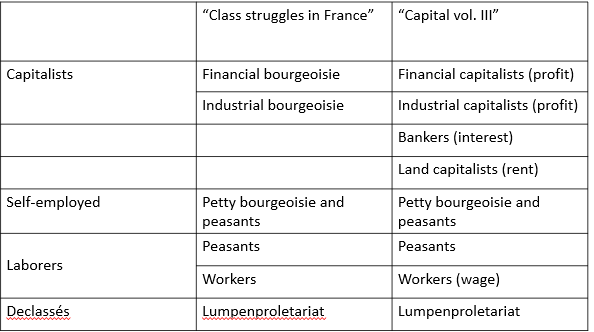
Note: from my “Visions of Inequality”.
Ishchenko’s class structure is much simpler. Before the war with Russia, Ukrainian society consistent of three large classes. The first was urban bourgeoisie that tended, by its own political preferences and material interests, to look towards Western Europe as a “civilizational project”, whereby Ukraine would become more developed socially and economically. Urban bourgeoisie was often supported by European or American money that came through various educational, technological, or social projects, or more simply, the urbanites had business and professional interests shared with Western Europeans. Thus the urban bourgeoisie had both a material interest and ideological preference for closer relations with Europe and in particular for the membership of the European Union. It is not clear at all that before the war that attitude extended to the membership of NATO. Ishchenko provides numbers on the support for NATO membership that never encompassed the majority of the population, and often not even the plurality. Until the Russian invasion, the membership of NATO was desired by 15 to 20 percent of the population whereas the membership of the European Union generally had the support of more than 50% of the population.
The second large class were extreme right-wingers and nationalists who mostly come from the western part of Ukraine and were instrumental in the overthrow of Yanukovich. As one of their leaders is quoted, “We were one-tenth of the people there but we did nine-tenth of the job”. The popular insurrection that lasted several months and involved many twists eventually led to Parliament (in a dubious way) impeaching Yanukovich who then fled to Russia, relinquishing all presidential powers. It is not very clear from Ishchenko’s essays what is the economic basis of these right-wing groups. Their political views together with their thuggishness, remind one most closely of the German SA. In fact, Ishchenko compares them implicitly so when he says that they are military wings of political parties. There are several of them, operationally independent, linked to various rightist parties. Among these groups the best known is the Azov brigade that participates very importantly in the war, providing the backbone of Ukrainian armed forces. It is an all-encompassing organization: “a unit with a political agenda affiliated to a political party, to a paramilitary organization, to summer camps training children.” (p. 116). There were also other groups that played the role in in the Euromaidan as, for example, the Right Block that originally was an association of soccer hooligans, similar to what exists in many East European countries. But it is not at all clear what social groups they represent nor what is their economic interest other than some form of corrupt political capitalism.
The third group in Ukraine before 2014—that is when Ukraine was still a unified country—were people in eastern Ukraine where big oligarchs, having gotten rich on fraudulent privatizations of Soviet industrial companies, controlled the political life “ruling” over a rather passive workforce. ”These oligarchic parties were structured around a ‘big man’, on patron-client relation, [and] lacking any other model they reproduced the worst features of the Communist Party of the Soviet Union—heavy handed paternalism, popular passivity—voided of its legitimizing modernity project” (p. 111). Unlike the urban bourgeoisie, here both the oligarchs and the population looked towards Russia with whom they had economic and ethnic ties. They were keen to maintain privileges in that trade and were fearful of economic competition from the Western countries if Ukraine were to become an associate or full member of the EU. They represented what one might call conservative interests—what in Yeltsin’s era used to be called the “Red Directors” who have been transformed into oligarchs--but their support was, Ishchenko argues, rather shallow in that it depended on passivity of the workers rather than on their enthusiastic support.
The “Eastern oligarchs” appealed to the media and to the rest of the population than the “Western oligarchs” and the urban bourgeoisie because the latter were more sophisticated and included many highly educated professionals. Media scene in Kiev and other large cities was dominated by what Ishchenko calls national-liberal urban middle classes, paid very often by Western business contracts and Western NGOs. They could be also seen as a comprador bourgeoisie.
The “Western oligarchs”, who also got rich through fraudulent privatizations but in their businesses were Western-oriented, played a complex role whereby at times they sided with the extreme right-wing and at other times with national-liberal coalition. Petro Poroshenko may be the best known case. He became the president of Ukraine after Yanukovich’s ouster; oligarch himself he shifted from a national liberal position toward extreme right which allowed Zelensky in the next election to present himself as a peace candidate and to win with a landslide (with 73% of the vote in the second round). Ishchenko argues that the main reason for this ambivalent positioning of Western oligarchs was the issue of corruption. Getting closer to the European Union was in principle something they supported, but not when it involved greater scrutiny of their contracts and tighter rein on corruption. Greater transparency and control over corruption that would come with closer European relations was for them always an issue, and at time, it would lead them to move closer to extreme nationalists who were uninterested in such trivial topics like corruption.
What happened with the 2014 limited war and the rebellion in the Donbass was that the third group (“Eastern oligarchs” and workers) became totally excluded from the domestic polity because they either joined separatist or Russian forces, or they were cut off because the territory was occupied by Russia or anti-Maidan Ukrainian forces. That left on the ground only two social classes, namely the national liberal urban bourgeoisie and the right-wingers with their armed battalions. The latter carried a brunt of the war and I do not think there can be any doubt that when the war is over they would aspire to get top positions in government.
One group that has been totally eliminated during the past decade (and Ishchenko in the Introduction alludes to the fact that he and his family belong to it) are the so-called “wrong Ukrainians” or “Soviet Ukrainians”. They were (and one needs to speak of them in the past tense) the Sovietized urban middle class, whether technical or liberal intelligentsia, that shared socialist values while rejecting Soviet conformism; they accepted the progressive values brought up with the Soviet Union including not seeing the language as a marker of nationalism but as a tool for communication. As Ivashchenko rhetorically asks in the Introduction, “Did the Ukrainian speakers in my family feel oppressed when they spoke in Russian? On the contrary, it was the language of their loving partners, of the big cities, of higher education, the language spoken by most of their peers and colleagues in the technical intelligentsia. For them, it was not the language of oppression, but of advancement, as for millions of other Ukrainian families.” As in all wars that pit one extremist group against another, those in the middle get squeezed out. They are eliminated socially, and at times physically.
On top of that the party that was possibly closest to them, the Ukrainian Communist Parry (with 13% of the vote in 2012 elections), was banned in 2019 when the process of so-called decommunization was in the full swing. The “wrong Ukrainians” were first destroyed through the deliberate government action against any group that advocated a peaceful cohabitation of Ukrainians and Russians. Then they were additionally destroyed when Russia attacked Ukraine and, as Ishchenko points out, no group or party (outside of Donbas) –however close to Russia it might have been considered before the aggression—came out in support of the invasion.
The two main groups, national liberal bourgeoisie and right-wing nationalists, would thus remain after the war. The latter would probably prefer a type of political capitalism and clientelism that would dispense favors to their members. It is a general occurrence that after the war former soldiers and warriors believe that they should be especially rewarded for the sacrifices they made. It would not be surprising if the nationalists set their sights to controlling the top power. If they do so they would do it with a very clear agenda that would be based on revenge over Russia (l’armée de la revanche), return of the occupied territories, all of which would (as I think Zelensky once remarked) make Ukraine turn into an armed camp ready to pounce on Russia at any moment. A very optimistic version of what Ukraine might become is South Korea that under Western protection developed into a very prosperous country with advanced technology and thriving arts. A bad version of what could happen to Ukraine is that it looks like South Vietnam: lots of political instability, short-lived government, high levels of corruption, loss of population, and perhaps a general breakdown of representative institutions. If this were to happen the post-war Ukraine might resemble the pre-war Ukraine (four presidents, seven prime ministers, and five general elections between 2000 and 2022) even if one source of instability—difference in political preferences between the West and the East—would have disappeared due to the partition of the country.
In the late 1940s, British historian AJP Taylor, after studying the Habsburg dynasty from 1809 to 1916 and reviewing all failed attempts to create a functional multi-ethnic society in Central and Eastern Europe, asked a rhetorical question whether such a society is at all possible in Central and Eastern Europe. He thought that Tito’s Yugoslavia, if it survives, would provide an answer. I read Taylor’s book during the violent break-up of Yugoslavia and I thought that, indirectly, it was the most useful book to explain why such a nation cannot exist in Central and Eastern Europe. I never thought that I would have to go back to AJP Taylor to understand the break-up of Ukraine, but in reality the same pattern existed there too and it is not impossible to think that it may spread further East, to the Russian Federation.
Branko, once again I find your analysis intellectually interesting but extraordinarily selective.
You devote considerable attention to Ukrainian nationalism, oligarchic corruption, and internal political divisions, but remarkably little to Russia's role in exploiting those divisions through military intervention and territorial conquest. You even characterize Ukraine's possible determination to recover its occupied territories as a threat of aggression against Russia.
This resembles your earlier criticism of Eastern European countries for joining NATO, which you portrayed as hostility toward Russia. You seemed to overlook the obvious fact that these countries had experienced Russian domination and territorial ambitions for generations, under successive Russian political regimes. Their desire for protection was hardly inexplicable.
The recurring problem is that you treat Russia's historical grievances and security concerns as worthy of serious consideration while giving remarkably little comparable weight to those of its neighbors.
Why does Ukrainian nationalism warrant comparison with Hitler's SA while Russian imperial nationalism, which has actually produced a war of territorial conquest, receives so little attention?
Your political-economic analysis would be considerably more persuasive if you applied the same analytical standards to both sides.
This is the type of analysis that Mearsheimer misses entirely in his balance of power, realist theory. In that framework, one doesn't have to know anything about the internal dynamics of states. The class dynamics of Ukraine, and the political economy of Russian strategy is also missing from Richard Sakwa's excellent work on the war's origins. Sakwa reduces the internal conflict to ethnic and linguistic identity. It is smart to read these three contributions in relation to each other. The result is much better than the liberal garbage that is produced by the likes McFaul and Menon.
I'm surprised you didn't reference the social historians on 1917 (Mandel, Smith, or the unrivaled Rabinowitz). Pipes is a hack, not worth reading at all.