A different game
On football’s extreme commercialization

As people who read my Substack and other short pieces might have noticed I have not commented on almost anything regarding football in the past several years. I have lost quite a lot of interest, in part because of the interruption brought by covid (and the sad spectacle of empty stands and piped-in supporters’ noise generated by TV producers), and was then increasingly alienated by the extreme commercialization of the game. It is not that professional football (soccer) was ever free of money and commercial interests. But, keeping in step, with neoliberal commodification, it has become so brazenly and openly commercialized that some of its original features that made football stand out among sports have been lost. A sport that has historically been grounded (and not only in England, the cradle of football, but in all countries where it has spread in the twentieth century) in the local and the class (bourgeoisie vs workers; mixed heritage vs. White; right-wingers vs. left-wingers) has now become a deracinated sport. It has grown unmoored from most of its local, national or class roots. It is even doubtful, I think, to what extent it can be called a “sport” any more and not an “entertainment” in the sense in which the term is used by Hollywood and Madison Avenue.
I do not think that these critiques of the current state of football, and implicitly of its associations (FIFA and its constellation of regional groupings), is new. People have been saying this for years. And it has steadily grown worse. Perhaps the sight of this year’s Champions’ League final brought it home more than ever. Without going into the details of the game, I think it would not be unfair to summarize it by saying that (a) it was a very boring game and devoid of individual sparks of genius, and (b) it was just physical and tactical. Players, whose physical prowess, conditioning, and endurance are extraordinary, looked more like creatures from an AI-generated computer game than footballers of the past. There was no Omar Sivori who refused to wear shin-guards, no disheveled, cocaine-driven Maradona, no Garrincha half-asleep at the right-wing, no pot-belly Ferenc Puskas who could not run 100 meters and yet would score hundreds of goals, no fifth Beatle, no crazy individual. There were accordingly no unexpected passes, no incredible dribblings, no solo actions, no bizarre moves. But there was lots of tactical prevarication, with players lined up as Roman legionnaires executing a difficult maneuver before entering the battle, and performing their narrowly-circumscribed duties at perfection.
To add to this lack of genius and plethora of tactics, the winning team is largely an artificial creation, implanted in one of the largest capitals of Europe—not known for its love of the game—by foreign money. It has indeed acquired a strong following now, but that following itself has not birthed the team; it has never been powerful or passionate enough to create a team. On the contrary, the following was created once the team has become famous. There was no internal, endogenous growth that, step by step, over the years would have created a team. It is the same as if instead of planting trees to provide a shade, one were to simply uproot the trees from the forest and plant them on the sidewalk. Indeed, both provide equal shade at the time of heat. But one set of trees would have been created by a community that would oversee, over the years, its execution; the other would be brought in by the developers. The developers, in this case as in several others, simply decided to invest money in football rather than in building new city blocs. That’s how the winning teams are created nowadays. Socially, ex nihilo.
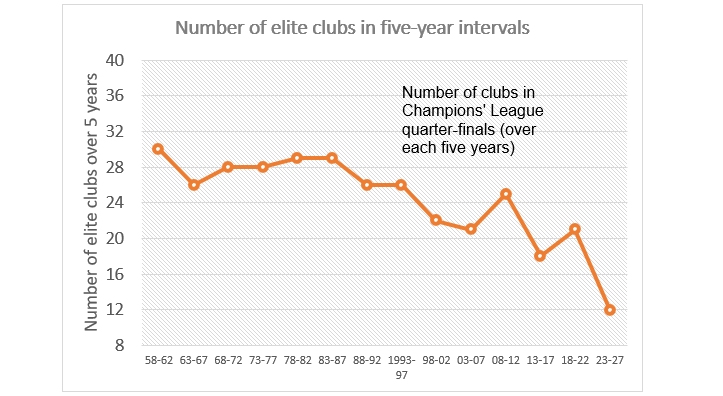
The winning teams are, not surprisingly, more and more the same: in the Champions’ League, an average of 25 teams were quarter-finalists in every five-year cycle from 1958 up to the early 2000s; since then, the number has gone down to around 20, and in the latest cycle is likely to be only 15 (see the figure, and explanation below). The very end of boredom will be reached when each season the same eight teams are quarter-finalists.
The spectacle –for it is indeed now a spectacle—has acquired characteristics of a circus, very much in sight in this year’s final. Calling out the players’ names with an exaggerated accentuation, setting fireworks, bringing in enormous screens (like in the new Bernabeu in Madrid), announcing the entrance of players into the arena as if they were gladiators, reminded me of what American football has become. It is a sort of a sport, just a “sort”—but devoid of all the characteristics of localism and class that I mentioned before. The teams may move from one city to another, the franchise is there to make money. The football franchises of FIFA and UEFA are now giant companies: players are entertainers, the game is a circus, and the businessmen are there to pocket the money.
Explanation of the graph. Figure shows the number of teams that are the quarterfinalists in each five-year cycle of the Champions’ League (or the European Cup as it was called earlier) beginning with the 1958-62 cycle. With the competition most equalized, there would be every year, eight different teams in the quarter-finals and thus the most egalitarian Champions’ League would have 40 different teams in each five-year cycle (5 times 8=40). The highest number in the graph is 40. The most “monopolized” or “centralized” competition would have the same eight teams in quarter-finals each year. Thus the lowest number in the graph is 8; consequently, the higher the value, the more equal the League. The Champions’ League went from having about twenty-five different teams in each cycle up to the early 2000s, to only twenty, and now in the current cycle, running from 2023 to 2027, the number is likely to be around 15 (the current value, after three years, is 12).
PS. This critique of FIFA and UEFA should not make one forget that an even worse association is the one ruling tennis. I wrote about that several years ago (“The age of open financial imperialism”) when I had a discussion with Nate Silver. The tennis association is as outrageously commercialized as the football association, but is, in addition, not elected by anyone and is monopolized by a couple of rich individuals from rich countries, so much so that tennis’ “World Cups” are always played in the same venues, years after year. This kind of monopolization has, luckily, so far failed to take hold in football, but it not impossible to imagine that it might. Then the Champions’ League final will be always played in the same venue, with more or less the same teams, and the World Cup will forever be held in one or two countries.
As an Arsenal supporter, I didn’t find Saturday’s game boring—quite the opposite.
Joke aside, there are two elements to this. First, emotional connections to the game—whether to a team, player, manager, or even a particular era—are an integral part of sport. Second, the game evolves by building on how it was played before. Raphael or Michelangelo may have been the greatest painter and sculptor of all time, but that does not mean contemporary artists should paint or sculpt exactly as they did. The same applies to football. Like most sports, it has always been, in one form or another, both a political and a commercial enterprise. Yugoslavia vs. USSR in 1952 was about much more than a football match.
Having said that, something is rotten in the state of UEFA and FIFA. It is almost impossible today to imagine Ajax, Red Star Belgrade, or Steaua Bucharest winning the Champions League unless some crown prince decides to create a new PSG in a smaller country.
How do "winner take all markets" fit into this story?